


EUDR 2026 – new deadlines, the simplification package and what listed companies need to do now


The EU Deforestation Regulation, EUDR, has been postponed twice since it was adopted in May 2023, and now applies from 30 December 2026 for large and medium-sized companies¹ and from 30 June 2027 for micro and small companies. In May 2026, the European Commission also presented a simplification package estimated to reduce companies’ compliance costs by around 75 percent. The core of the regulation is unchanged, but there have been several developments worth knowing about.
This article explains what EUDR means today, who is covered, what the reporting obligations entail, and what the simplification package means in practice. We also look at how requirements differ across sectors and how EUDR data can be integrated with CSRD and CSDDD – to avoid parallel and costly reporting tracks. For a broader picture of the surrounding regulatory shift, we refer to our earlier article on Omnibus and CSRD.
What is EUDR?
EUDR is the EU Deforestation Regulation, adopted on 31 May 2023. EUDR replaces the earlier Timber Regulation, which prohibited trade in timber and wood products from illegal logging on the EU internal market. The Timber Regulation continues to apply to wood produced before June 2023 until the end of 2027.
EUDR prohibits the seven commodities cattle, cocoa, coffee, palm oil, rubber, soya and wood from being placed on the EU market if they originate from land that has been deforested or degraded after 31 December 2020. The same applies to around fifty products derived from these commodities – ranging from chocolate and tires to furniture and paper.
The regulation placed three requirements on companies that import, sell och export the relevant commodities and products:
- Products must be deforestation-free. They must not originate from land that has been subject to deforestation or forest degradation after 31 December 2020. The requirement applies to the entire supply chain, meaning companies need to have control over the origin of commodities or products from the point of production all the way to the end market.
- Production must comply with legislation in the country of production. This may include rules on land use, environmental protection and labor law. Companies must be able to demonstrate that commodities or products have been produced in accordance with the laws and regulations applicable in the country of origin.
- A due diligence statement must be submitted. The company must carry out a risk assessment and report that the requirements are met. A key part of the due diligence process is that companies must be able to provide geographical coordinates for the plot of land where the commodities or products were produced.
Two delays and current deadlines
Originally the regulation was set to enter into force on 30 December 2024, but following extensive criticism from industry, which led to the need for simplification, the entry into force has been postponed twice. The dates currently in force are:
- 30 December 2026 for large and medium-sized companies
- 30 June 2027 for micro and small companies and natural persons.
The latest postponement proposal also contained three substantive changes. First, a new category was introduced – downstream operators – who may refer to existing due diligence statements without carrying out their own risk assessment. Second, books and newspaper were removed from the product list. Third, the Commission was tasked with conducting a simplification review.
Actors in the supply chain
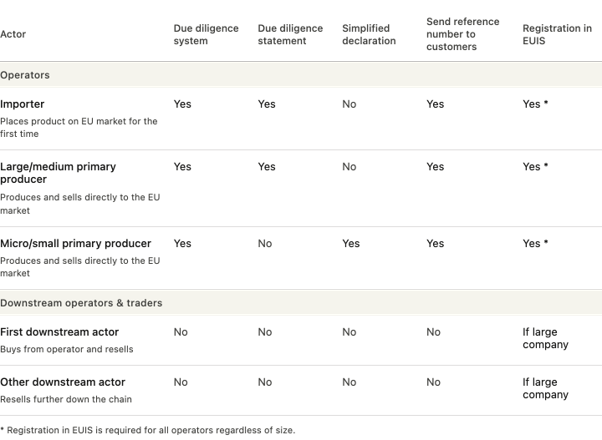
The regulation identifies two main categories of actors plus the new category introduced in December 2025:
- Operators. Those who place a relevant product on the EU market for the first time or export it. Most heavily regulated, with full due diligence obligations. Certain allowances exist for SMEs.
- Trader. Those who resell a product already placed on the EU market. Note that for non-SME traders, the same requirements apply in practice as for operators.
- Downstream operators. New category from December 2025. May refer to upstream due diligence statements without needing to carry out a new risk assessment.
Two concrete examples illustrate the difference between operators and traders. When coffee beans are harvested outside the EU and sent to a roastery within the Union, the roastery becomes the operator as it is the actor first placing the product on the EU market; when the roasted coffee is sold in a grocery store, the store acts as a trader. The same logic applies to timber: if wood is felled outside the EU and sent to a furniture manufacturer within the Union the manufacturer becomes the operator, while the retailer of the finished furniture is the trader. If the furniture is manufactured outside the EU, the actor first importing and selling the product within the Union becomes the operator instead.
The regulation applies regardless of company size. Even the smallest company placing a relevant commodity or product on the EU market must comply with the requirements. However, size affects both the deadline for when requirements begin to apply and the scope of obligations. Micro and small companies that are operators may, for example, submit a simplified declaration instead of a full due diligence statement. Financial institutions are currently exempt, but the issue may be revisited at the Commission’s upcoming reviews.
Due diligence – three mandatory steps
Each operator must complete three steps for each consignment before the product is placed on the market or exported:
- Information gathering. The company collects product description and HS code, quantity, country of production, geolocation of each plot of land where the commodity was produced, date of production, supplier name and address, and verifiable evidence that the product is deforestation-free and legally produced.
- Risk assessment. The operator assesses the risk that the product is non-compliant, based on country classification, supplier history, supply chain complexity, the level of corruption in the country of origin, and any substantiated concerns raised by third parties.
- Risk mitigation. If the risk is assessed as more than negligible, the company must act before the product is placed on the market. This may involve independent third- party audits, satellite-based verification, supplier training, supplementary documentation or change of supplier.
Once the three steps are completed, the operator submits a due diligence statement to the EU information system. The statement receives a reference number and a verification number that accompany the customs declaration and are checked at the EU border.
Geolocation. At plot level is one of the most demanding elements, and data volumes can be significant. For a Nordic pulp producer buying timber from tens of thousands of private forest owners, the requirement means that precis data and coordinates for each plot of land must be collected and managed in a due diligence system. For a cocoa buyer in West Africa or a coffee buyer in Vietnam, it means mapping the land of a very large number of smallholder farmers. The responsibility for the accuracy of the information rests with the operator. Large companies cannot place that responsibility on their supplier. For smaller companies, there is some possibility of doing this.
Country classification
EUDR classifies all countries into one of three risk categories for deforestation: low, standard or high risk.
The Commission published its first country classification list in May 2025, where only four countries were classified as high risk: Russia, Belarus, North Korea and Myanmar, all already subject to EU och UN sanctions. A large number of countries were classified as low risk, including all EU member states as well as countries such as the US, Canada, Japan, China, India and Vietnam. The remaining countries hold a standard risk level, for example Argentina, Bolivia and Gambia. The full EU country classification list is available here.
For imports from low-risk countries, neither risk assessment nor risk mitigation is required but information gathering, including geolocation, still applies.
May 2026 – the simplification package in six parts
The Commission’s 2026 package is the most recent development, estimated to reduce total compliance costs for affected companies from approximately 8 to 2 billion euros per year, a reduction of around 75 percent. The core text of the regulation is not open for renegotiation. The Commission’s package consists of six separate parts:
- Report to European Parliament and the Council – the statutory simplification review.
- Updated FAQ (version 5) with practical clarification.
- Revised guidance (version 3).
- Draft implementing act governing the information system.
- Draft delegated act amending Annex I – the single most impactful part for operators.
- New supply chain communication tool for supply chains.
The draft delegated act proposes that additional products be added to the regulation, but also that some be removed:
- Products proposed for addition: instant coffee and extracts, essences and concentrates of coffee; several palm oil derivatives, including soap made with palm oil; frozen cattle tongues.
- Products proposed for removal: retreaded rubber tires and hides and leather from cattle.
- New horizontal exemptions: product samples, single-use and reusable packaging, promotional materials, waste, secondhand goods and correspondence.
- ”ex”-prefix is introduced for several products to clarify that, for example, coconut oil, bamboo and synthetic rubber are not covered.
Different starting points across sectors
EUDR is the same law for everyone, but the practical work looks very different depending on which sector a company operates is:
- Forestry and paper are in a relatively favorable position compared to many other sectors. Many companies own the forest themselves or have direct relationships with forest owners, which makes it easier to collect the required geographic data. The main challenge is instead of a technical nature: connecting existing forest management systems to the EU information system so that statements can be submitted in live operations. Some Nordic actors have already made progress, while most have documented processes not yet taken into full operational use.
- Food with cocoa, coffee and palm oil face the greatest practical challenges among the sectors affected by the regulation. This is because supply chains are unusually long and complex. From a European manufacturer, the chain may run five or six tiers back through cooperatives and intermediaries, all the way down to tens of thousands of smallholder farmers spread across large geographic areas. Verifying exactly where each commodity was produced typically requires a combination of satellite monitoring and certification programs.
- Cosmetics and personal care are primarily affected using palm oil products and vegetable oils. The May 2026 draft proposes that more palm oil products be covered by the regulation, including soap made with palm oil, which would increase the number of products requiring due diligence in this sector.
- Tires and the automotive sector are affected through natural rubber, extracted from rubber trees. Synthetic rubber, manufactured from petroleum products, is not covered. A key challenge for the sector is traceability: it is currently relatively common to be able to trace rubber to the first collection point where the raw materials gathered from farmers, but mapping exactly which farmlands lie behind that is more difficult and requires further work. The industry organization Global Platform for Sustainable Natural Rubber (GPSNR) is working to coordinate efforts. The May 2026 draft proposes that retreaded rubber tiers to be exempted from the regulation, which would reduce the burden on the tire industry’s aftermarket.
- Textiles and fashion are affected in two ways: viscose and other wood-based fiber, and through leather from cattle. For viscose, the situation is relatively manageable as production is concentrated among a limited number of fiber producers globally, making traceability easier to establish. Leather is more difficult, however. Cattle typically move between several farms during their lifetime and pass through slaughterhouses, tanneries and several processing stages before reaching a clothing manufacturer, with each step making it harder to trace the origin to a specific plot of land. The May 2026 draft proposes that leather and hides from cattle be exempted from the regulation, which would be a significant relief for the fashion sector.
Supervision and sanctions
In Sweden, the Swedish Forest Agency has been designated as the competent authority and is responsible for supervision, controls and reporting to the EU. Supervision is risk-based: the authority must annually check at least 3 percent of operators per commodity category, or 1 percent for imports from low-risk countries. Controls take place in part through the digital information system where companies submit their due diligence statements.
The EU requirements national legislation to give authorities the power to impose fines of up to 4 percent of a company’s total EU turnover in the preceding year. This is not a mandatory standard fine, authorities assess each case individually and may impose lower amounts. However, member states may not cap that power below 4 percent. Other sanctions include confiscation of products and revenues, temporary trade bans for serious infringements, and exclusion from public procurement for up to twelve months.
Integration with CSRD and CSDDD
EUDR, CSRD and CSDDD are separate regulatory framework with different scopes, but for many companies they overlap i practice. The supplier mapping and risk assessment required by EUDR can advantageously be coordinated with the due diligence required by CSDDD across the entire value chain, even though CSDDD also covers human rights, which EUDR does not.
Whether and how EUDR data can be used to meet requirements under CSRD, such as ESRS E4 on biodiversity and ecosystems, depends on the company’s situation and should be assessed on a case-by-case basis.
The Omnibus 1 Directive changed the threshold for both CSRD and CSDDD. CSRD now applies to companies with more than 1 000 employees and net turnover above €450 million, while CSDDD applies to companies with more than 5 000 employees and turnover above €1.5 billion. Omnibus has no direct effect on EUDR, meaning that companies which, after Omnibus, fall outside the scope of CSRD or CSDDD may still be subject to EUDR.
What should companies do now
Ahead of the application date of 30 December 2026, there are six areas of particular importance:
- Determine your role in the supply chain. Establish whether the company is an operator, trader or downstream operator. This must be done per product line, as the role may differ between product areas within the same group.
- Build the right data structure from the outset. The regulation requires precis geographic data on the plots of land where commodities were produced. It is simpler and less costly to build this correctly from the start than to have to redo it later.
- Monitor regulatory changes during 2026. The draft delegated act was open for consultation until 1 June 2026, and a decision is expected during the summer or autumn. Companies with exposure to palm oil products, instant coffee, tires or leather should revisit their assessment of which products are in scope once the outcome is known.
- Coordinate with sustainability reporting. The data collected for EUDR may also be useful for sustainability reporting under CSRD and the forthcoming CSDDD. It pays to think through the data structure so that the same underlying data can be used in multiple places.
- Review supplier contracts. Contracts need to ensure that suppliers can deliver the necessary information on the origin of commodities in the correct format and on time.
- Communicate the sanction risk accurately. Fines can amount to four percent of turnover. Ensure that this risk is described correctly in client materials and in the annual and sustainability report.
Start early
EUDR is not a separate sustainability project but an operational and documented process that must be in place before the first consignment is shipped after 30 December 2026. For consumer goods companies with complex multi-tier supply chains, the application date is not a distant horizon. Supplier dialogue, contract amendments, data collection, satellite verification, ERP integration with the information system and internal training typically take 12 to 24 months in total.
AVA Corporate Communications works with financial communication, IR and sustainability reporting for listed companies. We help you navigate regulations such as EUDR, CSRD, CSDDD and Omnibus – from strategy and supplier mapping to due diligence and reporting. Get in touch if you would like to discuss your EUDR preparedness ahead of December 2026.
¹ Under the EU Accounting Directive (2013/34/EU), a company is classified as medium-sized if it does not exceed at least two of the following three thresholds: average number om employees of 250, balance sheet total of EUR 25 million and net turnover of EUR 50 million. Companies exceedingly at least two of these three thresholds are classified as large companies.


